
As some people age, the sheet-like muscle underneath the neck skin, known as the platysma, separates into bands creating vertical cords. These bands, and to a lesser extent the horizontal lines of the neck, can be temporarily improved with the muscle-relaxing effect of Botox® injections.
Botox injections for neck bands at Nu Vela are performed by Raffi Dishakjian, MD.
Neck Band Treatment at a Glance
- Cause: as some people age, the platysma, the sheet-like muscle underneath the neck skin, separates into bands creating vertical cords.
- Treatment: Botox®, or the equivalent Dysport® or Xeomin®, injected into each of the bands. The bands, and to a lesser extent the horizontal lines of the neck, can be temporarily improved.
- Results: start a few days after the injections and may last up to six months. Results may vary from person to person.
- Best suited to: people who do not have a lot of excess neck skin.
- Loose neck skin: when the neck skin is very loose, a surgical neck lift is the most effective treatment. Mild looseness can be corrected by light-based skin tightening, such as Titan™ or SkinTyte.
- Performed by: Raffi Dishakjian, MD, who performs all Botox injections at Nu Vela.
How Neck Bands Are Treated
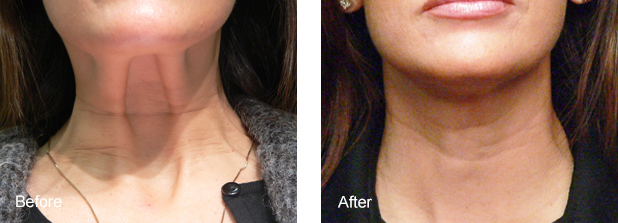
BOTOX® FOR NECK BANDS
Typically, Dr. Raffi Dishakjian, the cosmetic surgeon at the center, will inject 10 units of Botox®, or the equivalent Dysport® or Xeomin®, into each of the bands to significantly reduce them. Results from Botox® treatment of neck bands start a few days after the injections and may last up to six months.*
This procedure is particularly suited to individuals who do not have a lot of excess neck skin. When excessive looseness of the neck skin is present, a surgical neck-lift is the most effective treatment. Mild skin looseness, on the other hand, can be corrected by light-based skin-tightening therapies, such as Titan™ or SkinTyte, available at our medical spa, Nu Vela.
Click Botox®, Dysport, or Xeomin – FAQs to find the answers to questions you may have on the use, effectiveness, and safety of these products, or go to Botox® in cosmetic surgery to explore other applications of these products.
Please don’t hesitate to schedule an appointment with Dr. Dishakjian to find out if you are a suitable candidate for this treatment. You may contact our office by calling 818-832-4500.
*Results may vary from person to person
Neck Bands FAQs
Can Botox improve neck bands?
As some people age, the sheet-like muscle underneath the neck skin, known as the platysma, separates into bands creating vertical cords. These bands, and to a lesser extent the horizontal lines of the neck, can be temporarily improved with the muscle-relaxing effect of Botox® injections.
How long do Botox results for neck bands last?
Results from Botox® treatment of neck bands start a few days after the injections and may last up to six months. Results may vary from person to person.
When is a neck lift better than Botox for neck bands?
When excessive looseness of the neck skin is present, a surgical neck-lift is the most effective treatment.
Published Research on Botulinum Toxin for Neck Bands
In a phase 3 randomized, double-blinded, placebo-controlled trial of onabotulinumtoxinA (Botox) for moderate to severe platysma prominence (neck bands), participants received a total dose of 26, 31, or 36 units, based on severity, or placebo, and were monitored for 120 days. At day 14, 32.3% of the treated participants, versus 1.9% of those who received placebo, had reached minimal or mild severity with at least a two-grade improvement, as rated by both the investigators and the participants. Adverse event incidence was similar between onabotulinumtoxinA and placebo, and no events of dysphagia (difficulty swallowing) or muscular weakness were reported. A single treatment was evaluated.
The FDA-approved labeling of Botox Cosmetic (revised October 2024) includes the temporary improvement in the appearance of moderate to severe platysma bands in adults.
Sources:
- Fabi S, Humphrey S, Biesman B, et al. Improvement of platysma prominence with onabotulinumtoxinA: safety and efficacy results from a randomized, double-blinded, placebo-controlled phase 3 trial. Journal of the American Academy of Dermatology. 2025;92(2):285-291.
- Allergan, Inc. BOTOX Cosmetic (onabotulinumtoxinA) prescribing information. DailyMed, National Library of Medicine. Revised October 2024.