

Sun spots, age spots, and wrinkles, often attributed to aging, are in fact secondary to sun damage. With an average of 300 sunny days a year in Southern California, it’s difficult to avoid the intense sun rays at all times and prevent the formation of the ensuing bothersome symptoms on our bodies. Freckles, on the other hand, also caused by sun damage, are rarely attributed to aging—we all have seen freckles on the faces of children, sometimes as young as age 1 or 2.
Sun Spots, Age Spots and Freckles at a Glance
- Cause: sun damage. Sun spots and age spots, often attributed to aging, are in fact secondary to sun damage, and freckles are also caused by sun damage.
- Freckles: multiple, flat, circular spots which develop over sun-exposed surfaces. They are prominent in summer but fade considerably or disappear in winter.
- Sun spots: also known as age spots or liver spots: harmless, large, flat, gray, brown, freckle-like circular spots. Unlike freckles, these spots tend to persist and do not fade and darken with the seasons.
- When to see a doctor: although age spots do not change into cancerous growths, some skin cancers may resemble these spots. Anyone who has one or more uncertain pigmented spots should report them to a physician or dermatologist for evaluation.
- Prevention: the prevention of age spots requires sun avoidance and sun protection, which may also help to suppress the appearance of freckles.
- Treatment: chemical peels, and IPL (Intense Pulsed Light) photofacials, which target the melanin pigment responsible for the color of freckles and sun or age spots.
- Medical director: Raffi Dishakjian, MD, who founded Nu Vela Laser Medical Spa in 2005.
About Freckles
Freckles (also known as ephelides) are multiple, flat, circular spots which develop over sun-exposed surfaces, particularly the cheeks, nose, upper shoulders, and arms. The spots develop due to an increase in the amount of melanin, a dark pigment, in cells called melanocytes. Freckles are always darker than the surrounding skin and may be red, yellow, light brown or dark brown. They are prominent in summer but fade considerably or disappear in winter. Fair-skinned people, especially those with red hair, have an inherited predisposition for them. The prominence of freckles is related to sun exposure—sunburn makes them bigger and darker. Freckles caused by sunburn have irregular jagged borders and commonly appear on the upper back and shoulders where people get their most severe sunburns. There is no cure for freckles; however, several safe and effective methods are available to help lighten or reduce their appearance. Sun avoidance and sun protection may help to suppress their appearance.

IPL PHOTOFACIAL TREATMENT FOR FRECKLES
About Sun Spots and Age Spots
Sun spots, also known as age spots or liver spots, are harmless, large, flat, gray, brown, freckle-like circular spots, often with irregular borders. They vary in size from as small as a pea to as large as a nickel. Unlike freckles, these spots tend to persist and do not fade and darken with the seasons. Sun spots are common in those with fair skin but are frequently seen in those who tan easily or have naturally dark skin. Although these spots appear on the skin of older adults, age spots, or liver spots, have little to do with aging or the liver. They develop slowly over time and get bigger as our skin produces excess melanin (pigment) in response to overexposure to sunlight. It is for this reason that these spots usually appear on the face, hands, shoulders and arms—areas of the body most exposed to the sun. Accordingly, the prevention of age spots requires sun avoidance and sun protection. Sun spots are harmless and do not need to be treated; however, many people seek treatment because they believe these spots can detract from their skin’s appearance, making them look older. Although age spots do not change into cancerous growths, some skin cancers may resemble these spots. Accordingly, anyone who has one or more uncertain pigmented spots should report them to a physician or dermatologist for evaluation.
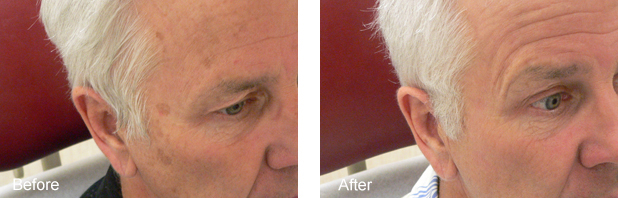
SUN AND AGE SPOTS TREATED USING IPL PHOTOREJUVENATION
Sun Spots and Freckles Treatment Options at Nu Vela
Traditional treatments for sun spots and freckles, such as topical bleaching agents and medications, often produce only temporary results. In contrast, Dr. R. Dishakjian, the cosmetic surgeon at Nu Vela, uses several effective and quality therapies to get rid of unwanted sun damage. The minimally invasive photorejuvenation light and laser technologies available at the Center are specially designed to reduce your undesirable age spots and freckles, and will even reduce any small facial veins.
During your consultation, Dr. Dishakjian will observe your skin tone to tailor a treatment that fits your lifestyle and matches your skin’s condition and your desired results. The cosmetic procedures designed to reduce the appearance of redness and age or sun spots available at Nu Vela are as follows:
Chemical peel
Safely uses one of the chemicals intended for skin peeling, from superficial to medium depth, to get rid of the undesirable spots. As the damaged skin peels, new skin forms to take its place. Superficial chemical peels require several treatments to achieve good results. Read more – Chemical Peels Los Angeles . . .
IPL Photofacial – Sciton’s BBL™ technology
Sciton’s BBL™ Skin Rejuvenation system, used at the Center, uses the most advanced and effective IPL technology on the market. The IPL system works much like a laser, but instead of having just one wavelength of light, the machine produces a spectrum of light made up of a range of wavelengths. By selecting an appropriate filter, your doctor will select the wavelength range to treat the damage caused by skin aging and sun exposure. Photothermal energy delivered by the BBL™ hand-piece will gently heat up the upper layers of your skin and target the melanin pigment responsible for the color of freckles and sun or age spots. Heat absorbed by the targeted areas will stimulate your skin cells to generate new collagen helping restore your skin to its natural appearance, fading the pigmented spots, blending the skin’s natural colors and making it smoother, vibrant and younger looking.
During the procedure, the doctor applies a cooling gel on the skin and directs pulses of light to your skin using the BBL™ hand-piece. You may feel a very slight sting, like the snapping of a small rubber band, which will soon subside. Any area of your body can be treated, and typically, two to four treatments, about 1 month apart, will produce the desired results. You can see some improvement with each treatment, but it’s common for your response to be slightly different with each treatment. The IPL procedure is non-invasive and gentle with virtually no downtime. You may even apply foundation or concealer immediately after treatment. More about IPL skin treatment.
Cutera’s Solar Genesis technology for sun and age spots removal
Solar Genesis is a pulsed light system that is exceptionally effective at treating undesired pigment discoloration. It is an innovative skin therapy to quickly, safely and comfortably remove freckles and sun or age spots from your face, chest, arms and hands. The treatment, which takes less than thirty minutes, delivers visible light which is selectively absorbed by the pigmented spots on your skin.
With Solar Genesis there is no need to apply topical anesthetic or gel before the procedure. Immediately following the treatment, freckles and the sun spots may start to darken and you may notice a slight reddening of the surrounding skin. This typically subsides within a couple of hours. Over the course of the next one to three weeks, the darkened sun and age spots will fade and flake off.

PHOTO REJUVENATION BEFORE & AFTER PHOTOS

SUN AND AGE SPOTS TREATED USING IPL PHOTOREJUVENATION
Sun Spots and Freckles FAQs
What is the difference between freckles and sun spots?
Freckles are prominent in summer but fade considerably or disappear in winter. Unlike freckles, sun spots tend to persist and do not fade and darken with the seasons.
Are sun spots and age spots dangerous?
Sun spots are harmless and do not need to be treated; however, many people seek treatment because they believe these spots can detract from their skin’s appearance, making them look older. Although age spots do not change into cancerous growths, some skin cancers may resemble these spots. Accordingly, anyone who has one or more uncertain pigmented spots should report them to a physician or dermatologist for evaluation.
Do age spots have anything to do with age or the liver?
Although these spots appear on the skin of older adults, age spots, or liver spots, have little to do with aging or the liver. They develop slowly over time and get bigger as our skin produces excess melanin (pigment) in response to overexposure to sunlight.
Is there a cure for freckles?
There is no cure for freckles; however, several safe and effective methods are available to help lighten or reduce their appearance. Sun avoidance and sun protection may help to suppress their appearance.
Published Research on IPL for Sun Spots and Freckles
In an open study of intense pulsed light for solar lentigines (sun spots) and ephelides (freckles) on the face, patients received three to five treatments. Forty-eight percent of patients had more than 50% improvement. In the group with solar lentigines, 40% of patients showed more than 50% improvement: patients with small plaques responded well, whereas patients with large plaques, alone or together with small ones, showed poor response. Among the patients with freckles alone, 71% had more than 50% improvement.
In a randomized, physician-blinded, split-face trial in Asian patients (15 with freckles and 17 with lentigines), one cheek had one session of a Q-switched alexandrite laser and the other had two sessions of IPL. All patients experienced improvement. The laser was superior to IPL for freckles. Postinflammatory hyperpigmentation (darkening of the skin) developed after the laser in one patient with freckles and eight patients with lentigines, and in none after IPL. The authors list a small case number and a short follow-up period as limitations.
Sources:
- Kawada A, Shiraishi H, Asai M, et al. Clinical improvement of solar lentigines and ephelides with an intense pulsed light source. Dermatologic Surgery. 2002;28(6):504-508.
- Wang CC, Sue YM, Yang CH, Chen CK. A comparison of Q-switched alexandrite laser and intense pulsed light for the treatment of freckles and lentigines in Asian persons: a randomized, physician-blinded, split-face comparative trial. Journal of the American Academy of Dermatology. 2006;54(5):804-810.
Questions about Cost or a Treatment?
You may reach our Los Angeles medical spa by clicking the “Contact” button at the top of the page, or by calling 818-832-4500. Our receptionist will be delighted to assist you with any inquiries regarding cost, additional information, or scheduling a consultation session with Dr. Dishakjian, the cosmetic surgeon of the center. Consultations with the doctor are free with the purchase of any service. We charge a nominal refundable consultation fee for the first office visit only. This fee is fully credited towards a subsequently purchased service.